
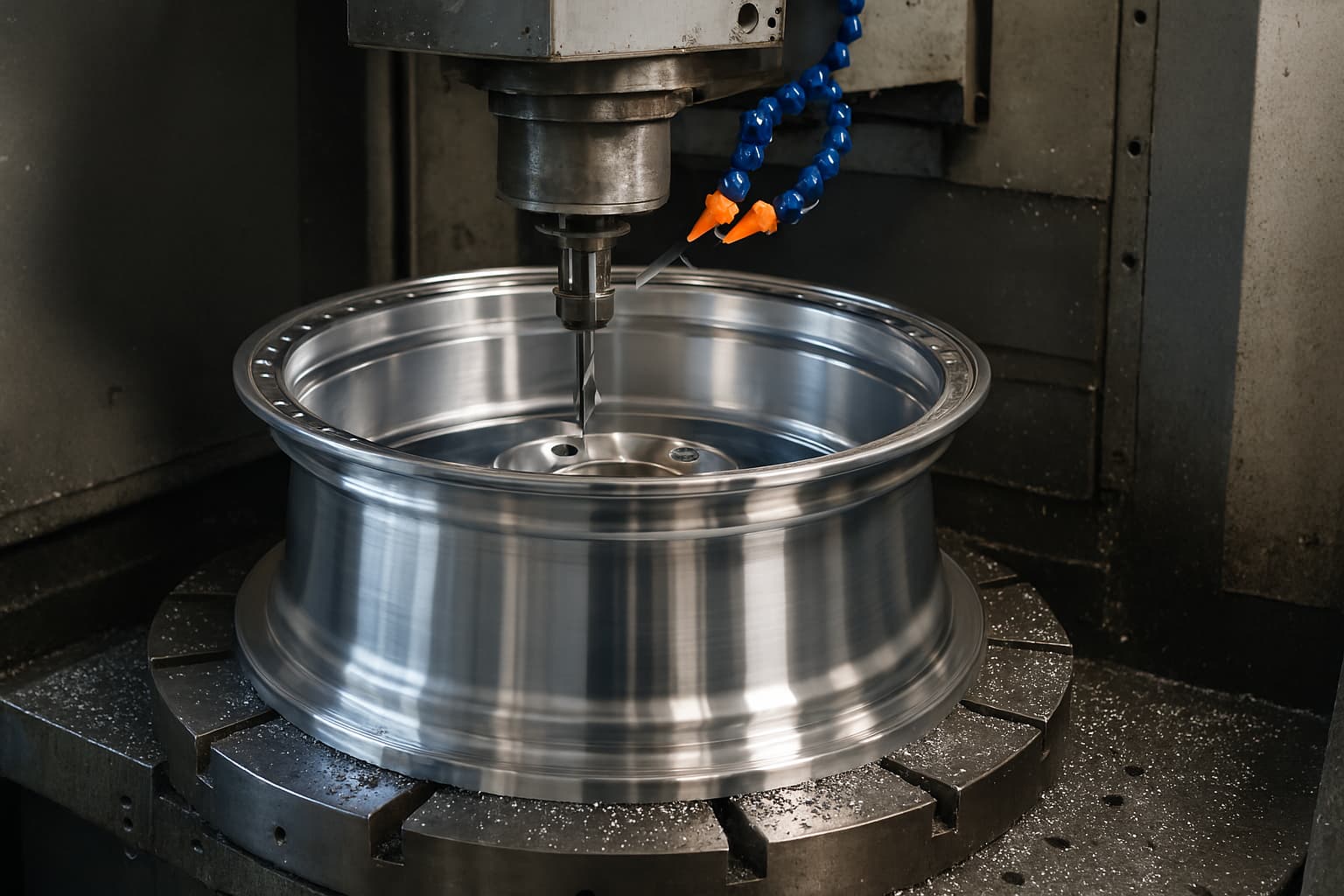
Computer numerical control machining technology is radically transforming the production of rim components by combining advanced automation and exceptional precision. This manufacturing methodology is establishing itself as the standard of excellence in the high-performance rim industry.
Understanding CNC: Definition and Fundamental Principles
The acronym CNC stands for "Computer Numerical Control." This technology represents a manufacturing process that uses computerized controls to operate machine tools, gradually removing material from a raw workpiece until the desired final shape is achieved.
How the CNC System Works
The CNC machining process relies on highly sophisticated automation, ensuring microscopic precision. Computer-controlled machine tools execute computer programs that precisely define every cutting movement, every material removal depth, and every tool path. This automation eliminates variations inherent in manual operations and ensures perfect repeatability between produced parts.
Key Features of CNC Machining:
- Precise computerized control down to a hundredth of a millimeter
- Full automation of the manufacturing cycle
- Perfect repeatability across production runs
- Ability to create complex geometries impossible manually
- Full traceability of machining parameters
The extraordinary precision of CNC allows for the production of components with tight tolerances required by the modern automotive industry. High-performance rims necessitate rigorous dimensional adjustments to ensure dynamic balancing, perfect alignment, and compatibility with contemporary braking systems.
Advantages of CNC in Rim Component Manufacturing
Computer numerical control machining has established itself as the preferred method for producing rim parts due to its unparalleled technical performance. Specialized manufacturers are widely adopting this technology to meet the growing demands of the aftermarket.
Exceptional Consistency and Precision
CNC delivers absolutely consistent results, eliminating dimensional variations between successive parts. This uniformity ensures that each component scrupulously adheres to technical specifications without any deviation that could compromise balancing or safety.
Benefits of CNC Precision:
- Dimensional tolerances less than 0.01 mm
- Absence of variations between parts from the same series
- Perfect concentricity ensuring optimal balancing
- Regular and repeatable surface finishes
- Guaranteed compatibility with standardized mounting systems
Unlimited Design Customization
The programmatic flexibility of CNC unleashes designers' creativity by allowing for the creation of complex patterns, sophisticated geometries, and bespoke configurations. This adaptability makes it possible to meet the most specific demands without costly investment in dedicated tooling.
Customization extends from non-standard bolt patterns (PCD) to custom center bores adapted for rare vehicles, as well as exclusive disk profiles and completely original spoke arrangements. CNC virtually transforms any digital design into tangible reality, opening unlimited horizons for automotive customization.
Superior Quality and Perfect Fit
The microscopic accuracy of CNC ensures a millimetric fit between modular rim components. The interfaces between the center disk, inner barrel, and outer lip feature perfectly machined mating surfaces, eliminating unwanted play that can cause vibrations and premature wear.
This precision of fit is particularly critical for three-piece wheels, where the perfect alignment of the bolt holes directly impacts the structural safety of the assembly. CNC ensures that each drilling aligns exactly with its counterparts to guarantee an equitable distribution of clamping forces.
Our Technological Investment: Haas Precision Lathe
In 2021, facing growing demand and to expand our product diversity, we integrated part of the manufacturing process by internalizing critical operations. The acquisition of a Haas precision lathe marks a strategic turning point in our customization capabilities and commercial responsiveness.
Capabilities of Our Haas Machining Center
This latest-generation machine tool gives us the autonomy to perform custom boring and PCD drilling operations for wheel disks and barrels covering a size range of 13 to 21 inches in just a few minutes. This versatility positions us as a comprehensive player capable of meeting almost all market demands.
Operations that can be performed in-house:
- Custom center bore from 50 to 150 mm in diameter
- Non-standard bolt pattern (PCD) drilling for specific applications
- Machining of outer lips to custom dimensions
- Modification of inner barrels for brake clearance
- Rectification of mating surfaces for optimal assembly
Benefits of Vertical Integration
Internalizing these critical operations provides substantial benefits for both our organization and our end customers.
Operational and Commercial Gains:
- Drastic reduction in manufacturing times from several weeks to a few days
- Elimination of intermediaries and total quality control
- Maximum flexibility to meet atypical requests
- Cost optimization by eliminating intermediate margins
- Unparalleled responsiveness to urgent customer needs
This manufacturing autonomy allows us to accept extreme customization projects that most of our competitors refuse due to lack of internal capabilities. A owner with a rare vehicle with a specific bolt pattern can now obtain perfectly adapted wheels without compromising quality or exceeding their budget.
Practical Applications of CNC in Wheel Production
Numerical machining technology is used at multiple stages of the modular wheel manufacturing process, from the initial blank to the final finishes.
Machining of center discs
Wheel centers require absolute precision on several critical parameters simultaneously. CNC machines the center bore to the exact diameter of the vehicle hub while drilling the mounting holes according to the specified bolt pattern with perfect concentricity. Simultaneously, the machine sculpts the spoke design according to the desired pattern while respecting the minimum thicknesses guaranteeing structural strength.
Shaping of lips and barrels
Peripheral components also benefit from CNC accuracy to obtain the complex profiles characteristic of high-end wheels. Machining generates multiple steps (single, double, or triple step) with precise angular transitions, creates negative profile concavities, or shapes flat surfaces in reverse flat style. Each operation is performed according to programmed trajectories guaranteeing perfect symmetry and repeatability between units.
Peripheral mounting holes
The hardware connecting the three sections of a modular wheel requires perfectly aligned holes between the disc, barrel, and lip. CNC simultaneously drills these bores, guaranteeing their exact angular positioning and absolute perpendicularity to the mating surfaces. This precision eliminates parasitic shear stresses on the bolts during tightening and ensures homogeneous load distribution.
Technological Evolution and Future Prospects
CNC machining continues to evolve with the integration of complementary technologies further increasing customization capabilities and final quality.
Recent innovations in digital machining
Contemporary machining centers now integrate in-process measurement systems that automatically correct thermal drift or compensate for progressive tool wear. These features ensure that tolerances are maintained even over extended production runs lasting several hours.
Emerging CNC machining technologies:
- Integrated laser measurement for real-time dimensional control
- Automatic compensation of thermal expansion of parts
- Trajectory optimization for cycle time reduction
- Intuitive human-machine interface simplifying programming
- Network connectivity enabling remote control and telemaintenance
Combination of CNC and metal 3D printing
The future of wheel manufacturing could see the convergence of subtractive CNC machining and additive metal manufacturing. This hybridization would allow the creation of lightweight internal structures impossible to achieve with conventional machining, followed by CNC finishing operations ensuring the required dimensional tolerances and surface finishes.
Maintenance and longevity of CNC machined components
Parts produced by numerical control exhibit superior durability thanks to the intrinsic quality of their manufacturing. The absence of residual stresses induced by approximate manual operations preserves structural integrity in the long term.
Preventive maintenance of CNC wheels
Although the initial quality is exceptional, proper maintenance maximizes the longevity of your customized wheels.
Maintenance recommendations:
- Regular cleaning with pH-neutral products avoiding chemical aggressiveness
- Periodic visual inspection of machined surfaces to detect nascent cracks
- Checking tightening torque after initial break-in and then annually
- Protection of finishes against corrosive road spray
- Storage in a dry environment during prolonged periods of disuse
CNC machining precision directly contributes to the preservation of dynamic balancing over time. Perfectly circular and concentric components are more resistant to progressive deformation than parts that initially have geometric deviations.