
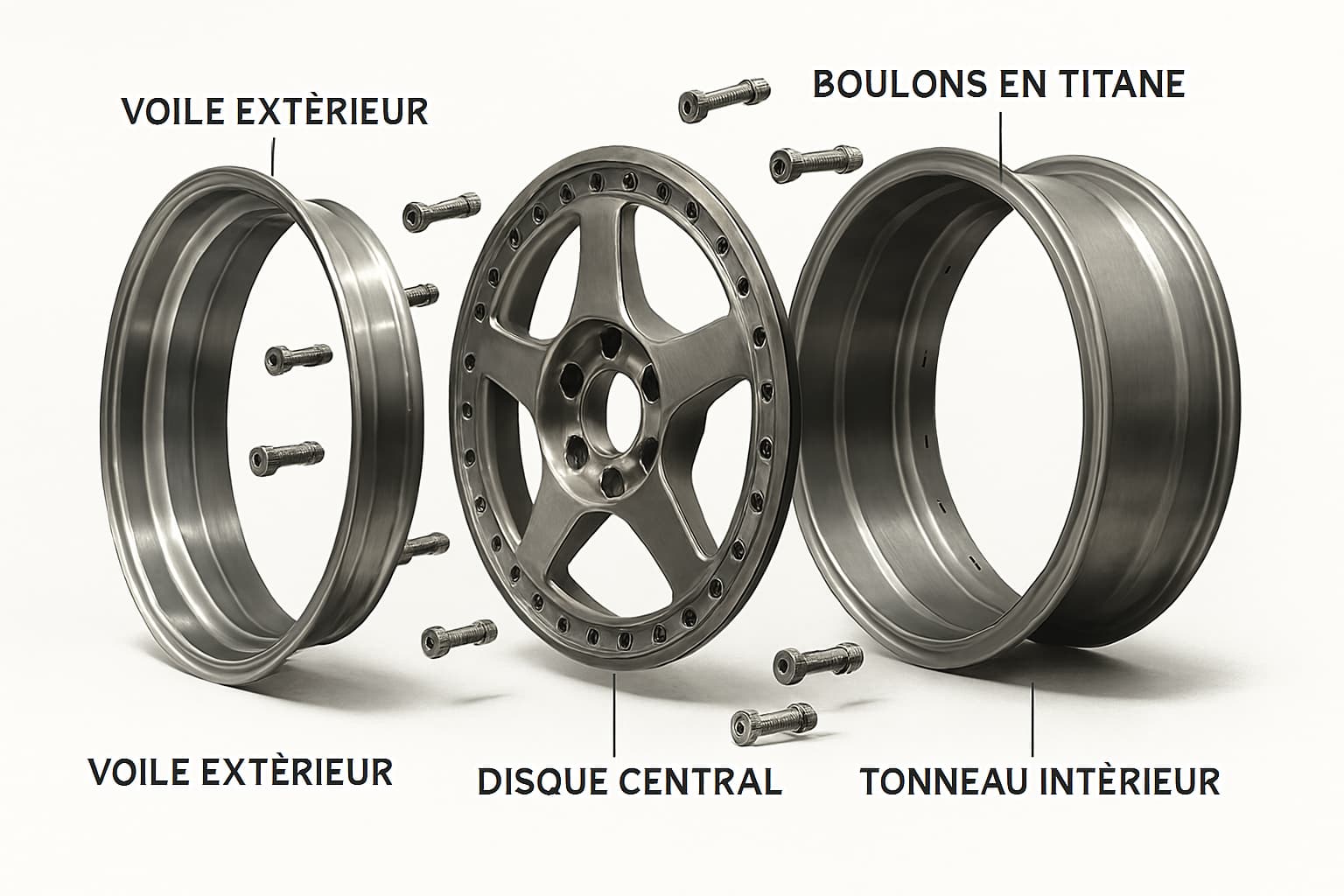
Three-piece modular rims represent the pinnacle of automotive customization thanks to their demountable design. Each constituent element fulfills precise functions that contribute to the overall performance and aesthetics of the wheel.
The outer lip: visual signature and technical characteristics
The outer lip, also referred to as "outer halve" or "outer bed", constitutes the visible peripheral element of the modular rim. This front component plays a dual role, combining mechanical functionality and stylistic expression.
Functions and characteristics of the outer lip
The outer lip defines the visual identity of the assembly while actively participating in the load-bearing structure of the wheel.
The main advantages of the outer lip include:
- Definition of apparent diameter and visible rim depth
- Possibility of customization with polished, brushed, or anodized finishes
- Direct influence on the offset and track widening of the vehicle
- Protection of the central part against lateral impacts
- Contribution to the torsional rigidity of the rolling assembly
The outer lip positions itself as the signature element that immediately catches the eye and reflects the character of the vehicle. Its dimension, finish, and geometry radically transform the overall appearance of the rims, allowing owners to assert their personal style while respecting technical installation constraints.
The inner barrel: invisible structural foundation
The inner barrel, known as "inner halve" or "inner bed", forms one of the three main sections of the modular rim alongside the center and the outer lip. This hidden structural element performs critical missions for the mechanical integrity of the assembly.
Essential roles of the inner barrel
This internal section constitutes the essential connecting link between the different components of the wheel while accommodating the braking components. The inner barrel directly conditions the mounting possibilities and the dynamic performance of the vehicle.
The main functions of the inner barrel include:
- Structural connection between the central disc and the peripheral lip
- Sufficient clearance for large diameter brake calipers and discs
- Influence on offset and total rim width
- Radial rigidity ensuring transmission of rolling forces
- Resistance to cyclic stresses during acceleration and braking phases
The inner barrel guarantees the solidity of the modular assembly while determining the permissible braking capabilities. This part dictates compatibility with high-performance braking systems and directly contributes to driving safety by maintaining perfect alignment between all constituent elements.
The wheel center: functional heart and vehicle interface
The wheel center, referred to as "center", "disk" or "face", represents the fundamental middle section of a three-piece modular rim. This central element provides the direct interface with the vehicle's hub and supports the entire rolling structure.
Characteristics and importance of the central disc
The rim center constitutes the anchor point where all forces transmitted between the vehicle and the road converge. Its design influences both the visual appearance and the dynamic behavior of the rolling assembly.
The essential attributes of the wheel center include:
- Attachment to the hub via the vehicle's studs or bolts according to the specific bolt pattern
- Determination of the offset (ET) which influences the position of the wheel in the wheel arch
- Spoke design defining aesthetics and aerodynamics
- Clearance for voluminous braking systems
- Resistance to bending stresses during intensive driving phases
The central disc can be customized with different spoke configurations (5, 6, or multi-spoke), various surface finishes, and even offset adjustments to optimize the running gear geometry. This design flexibility allows for precise adaptation of the rim's characteristics to the vehicle's technical requirements while expressing a distinctive visual signature.
The hardware: assembly and structural safety
The bolts, grouped under the generic term "hardware", constitute the essential fastening elements that solidify the three sections of a modular rim. This specialized hardware ensures the mechanical integrity of the assembly and directly conditions driving safety.
Critical functions of modular hardware
The peripheral fasteners connect the central disc, the inner barrel, and the outer lip to form a monolithic structure capable of withstanding extreme driving stresses. The quality and proper tightening of this hardware determine the overall reliability of the rim.
The essential missions of the hardware include:
- Solid maintenance of the three components under dynamic constraints
- Uniform distribution of clamping forces over the entire circumference
- Prevention of untimely disassembly during vibrations and shocks
- Possibility of disassembly for maintenance or configuration modification
- Contribution to aesthetics depending on the chosen finish (titanium, steel, color)
Bolts must be tightened to a precise torque specified by the manufacturer, usually applied in a star pattern to ensure even stress distribution.
The use of aerospace-grade fasteners (titanium or high-strength steel) with appropriate threadlocker is essential to prevent any progressive loosening that could compromise safety. Periodic checking of the tightening torque is part of the recommended preventive maintenance for modular wheels subjected to sporty or intensive use.